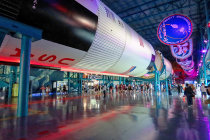
tat launch he Saturn V stood 110 meters tall
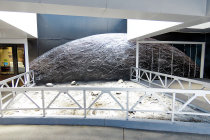
this is how the surface of the moon should look like
Kennedy Space Center at Cape Canaveral
To put a satellite in a stable
orbit you have to lift it at least 200 km and give it a forward speed
of a whopping 7.8 km/s.
Making use of the rotational speed of the Earth helps, at the equator you get .5 km/s for free if
you launch to the east.
NASA's
Kennedy Space Center KSC at
Cape Canaveral sits at the right position, being relatively
close to the equator and with thousands of km of empty ocean to the east if something goes wrong.
Spaceshuttle
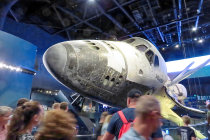
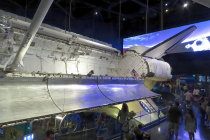
Atlantis performed its last manned flight in July 2011. Since then US astronauts fly to and from the International Space
Station aboard a
Russian Soyuz or a
SpaceX Dragon.




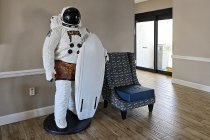
back at the hotel we meet an astronaut ready to go surfing
American pride
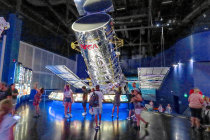
like the Hubble Space Telescope


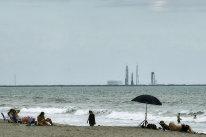
from Cocoa Beach you can see Launch Complex 39A where SpaceX is constructing the Starship launch tower
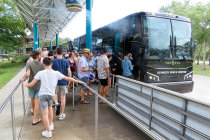
a bus brings us back to the Visitor Center
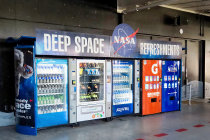
space coke
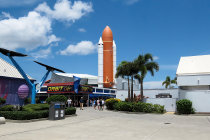
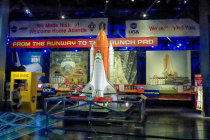
a towering model of the Spaceshuttle rocket
via the huge loading bay large satellites were put in space
the rear end of the massive Saturn V rocket
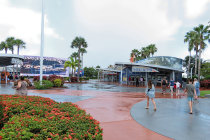
the rain just stopped when we arrive at Kennedy Space Center
in the Rocket Garden there is a line-up of rockets from the 70 ties
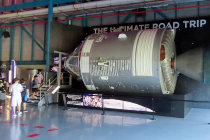
in the Apollo/Saturn V museum there is this copy of the Apollo Command and Service Module
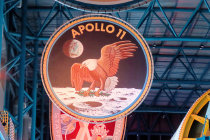
the Eagle landed on the Moon on July 20 1969
the retired Spaceshuttle Atlantis has its own hall of fame